

What do you hope to achieve with your project, and how will you ensure that your objectives are clear to everyone involved? The SMART model is a tool that can help you formulate objectives that are realistic and easy to work towards.
Using the SMART model, you break down your objectives into five clear criteria that make them easier to understand, follow and achieve. Whether you’re working on team leadership, project management or personal goals, the SMART method can provide you with a strong foundation for success.
Would you like to enhance your skills in a professional environment? See Mannaz’s training and programmes here
The SMART model is an effective tool for setting goals, ensuring that your goals are clear and achievable. By applying the SMART principles, you can improve your chances of success and provide a clear direction for your projects.
SMART is an acronym, which means that each letter in SMART stands for a word that is essential to the SMART model.
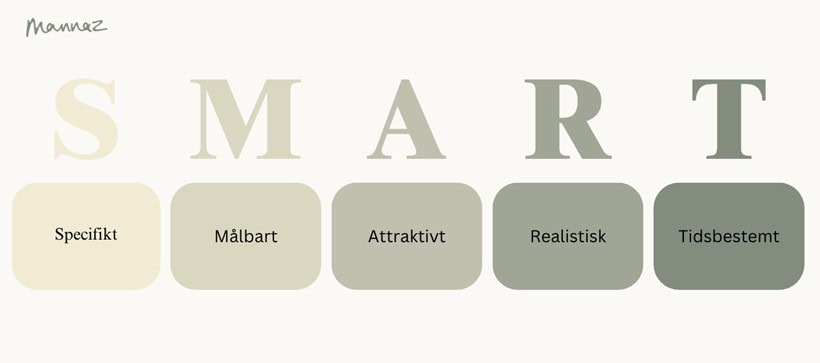
It must be easy to determine whether the objective has been achieved. Therefore, objectives must be precise so that there is no doubt as to what is to be achieved. A specific objective answers questions such as: What do we want to achieve? Who is involved? Where is it to take place?
If you cannot measure your progress, it is difficult to assess whether you are moving in the right direction. That is why the goal should have specific benchmarks, such as a particular figure, a percentage improvement or the completion of a task.
See also Mannaz’s courses in PRINCE2, Scrum and SAFe.
The goal must be meaningful and motivating for those working towards it. When the goal provides value and fosters a sense of ownership, the likelihood of success increases. An attractive goal takes into account both organisational and personal ambitions.
Ambitious goals are important, but they must also be realistic. If a goal is unrealistic, it can lead to frustration and a lack of commitment. It must be achievable within the available resources, skills and timeframes.
A target without a deadline risks being postponed. It is therefore essential to set a clear timeframe that creates a sense of commitment and prioritisation. A fixed deadline or milestones along the way ensure that progress is maintained.
The SMART model enables you to break your goals down into smaller, more manageable steps, thereby transforming your ambitions and aspirations into specific and achievable goals.
SMART goals act as a GPS for your project, guiding you and your team towards the desired outcome. When goals are clearly defined and meet the five criteria, the likelihood of success increases because everyone involved understands the goal and works towards the shared objective.
That said, it is important to remember to evaluate and adjust the goals on an ongoing basis. Projects can evolve over time, and it is important that the goals remain relevant and achievable – even if the surrounding context has changed.
By integrating the SMART model into your goal-setting process, you create a structured and effective approach to achieving your goals, which benefits both you and your organisation. The model is particularly valuable in project management, where it ensures clear expectations and measurable progress.
The SMART model can certainly be an effective tool for you, but how do you apply it in practice? Here, we provide a step-by-step guide to help you ensure that your goals are specific, measurable and realistic.
If you’d like to develop your leadership skills and learn how to use tools such as the SMART model in your work, we at Mannaz offer a wide range of development courses and training programmes.
For example, take part in our courses in agile project management or our renowned project management programme, and gain theoretical knowledge and practical training in planning projects, leading a project team and steering a project safely to completion.
First published on 10 February 2025

 4.7
4.7
A practice-oriented and realistic project management education with the possibility of an IPMA® certification.
 55.999 kr. ex. VAT
 7. oct 2026
 3 locations
 12 days
Project Management
4.7
12 days
Project Management
4.7
Become a PSM® I certified Scrum Master from Scrum.org.
12.499 kr. ex. VAT
10. dec 2026
Copenhagen
2 days
Project Management
4.5
Strengthen your product development through Lean-Agile competencies. Includes certification.
11.499 kr. ex. VAT
12. nov 2026
3 locations
2 days
Project Management incl. certification
4.4
The SAFe® Scrum Master strengthens the teamwork and development across the organisation .
11.499 kr. ex. VAT
29. oct 2026
Copenhagen
2 days
Project Management incl. certification
4.8
Create profitable projects with a combination of PRINCE2® and agile project management methods.
14.999 kr. ex. VAT
7. oct 2026
3 locations
3 days
Projektledelse Inkl. certificering
4.6
Skab endnu stærkere PRINCE2®-projekter med en kombination af PRINCE2® og agile metoder.
15.499 kr. ex. VAT
23. nov 2026
3 locations
3 days
Whether you’re facing complex challenges or simply want to optimise your processes, an experienced project management consultant could be the key to your success.
Take the first step towards effective results! Contact Henrik and let’s work together to achieve your project goals.

hbn@mannaz.com
+45 5139 6259
Gain more insight by signing up our newsletter.
