
26 February 2026
Leif Godsk, Consultant

In 2024, the Project Management Institute (PMI) conducted the largest study in the organisation’s 55-year history (Maximising Project Success). The aim of this study was to challenge the traditional view of project success. The study led to the development of a completely new and different way of defining and measuring project success.
A definition that takes far greater account of the different perspectives on success held by the project’s stakeholders.
The high rate of failed projects does not tell the full story, as projects vary, and project success should be viewed on a continuum rather than as a simple binary – pass or fail.
Perceptions of success can vary among stakeholders and evolve over time, reflecting changes in how they assess progress, outcomes and the value generated by those outcomes.
Looking at the above criteria for project success, the PMI study showed that the proportion of successful projects – projects that delivered results worth the effort and investment – grew significantly.
The new method for measuring project success is based on the premise that success cannot be measured in absolute terms – but is largely based on factors that vary depending on the situation and the individual key stakeholder’s perspective on value.
The method involves representatives from various, weighted stakeholder groups assessing the project’s success on a scale of 1–10. A score of 9–10 equates to success, a score of 7–8 to partial success – and a score of 0–6 equates to failure (see figure).
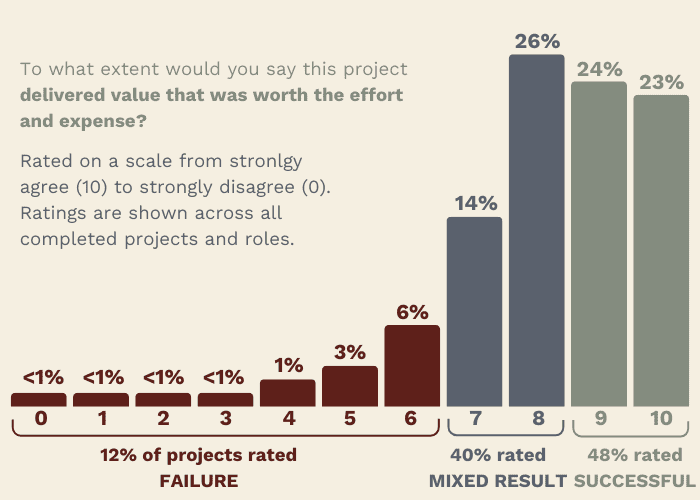
The above metrics are included in the calculation of the project’s NPSS (Net Project Success Score). In order to use the metrics for cross-comparison and benchmarking, a so-called Global NPSS is calculated. This is done by subtracting the ‘failed’ score from the ‘successful’ score. This figure represents the project’s Global NPSS.
The above is a good way to monitor the project’s success. Customers and key stakeholders do not so much assess the project on whether it met the exact deadline or exceeded the budget, but rather on whether the project delivered value to the individual that was worth the effort and cost. In addition, this also gives an idea of where optimising processes and approaches going forward will deliver the most value.
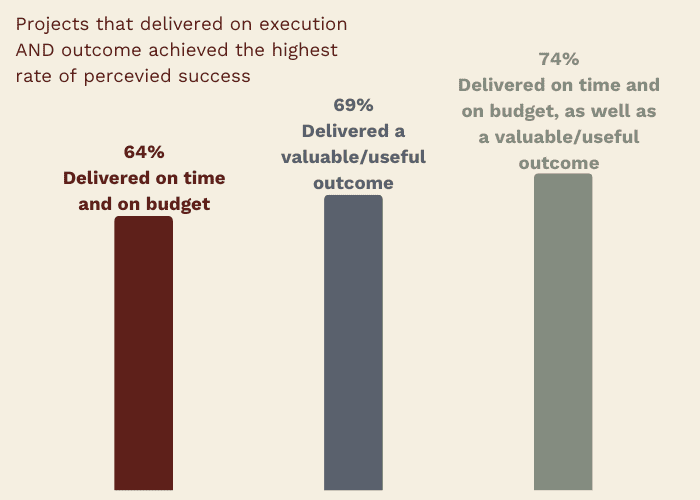
As shown in the figure above, it emerged that the projects in the study which achieved the highest success scores both adhered to traditional project frameworks and were also rated as the most successful by stakeholders.
For further insight, we recommend reading PMI’s survey “Maximizing Project Success”.
If we recognise that project success is a multifaceted concept in most projects, it becomes crucial for companies to focus on how projects that are perceived as crisis-stricken or at risk can be salvaged.
If your company has a well-organised ‘recovery plan’, failed projects can in many cases be redefined and implemented (Project Recovery) so that the success criterion ‘the benefit is commensurate with the effort’ is met.
In 2025, Mannaz will launch a Project Recovery course, which is designed to help turn around projects that are at risk. Project Recovery is based on the new definition of project success.
Please contact Mannaz if you require further information or assistance on how you or your organisation can benefit from this new approach to measuring and assessing project success.
The article was first published in March 2025 and has since been updated.
 4.7
4.7
A practice-oriented and realistic project management education with the possibility of an IPMA® certification.
 55.999 kr. ex. VAT
 2. dec 2026
 3 locations
 12 days
Project Management
4.2
12 days
Project Management
4.2
Become a Project Management Professional (PMP®) - Based on PMBOK® Guide PMI®.
29.999 kr. ex. VAT
30. nov 2026
Copenhagen
5,5 days
Project Management GET 16% OFF
4.7
Do you need tools to manage projects?.
25.999 kr. ex. VAT
4. nov 2026
3 locations
6 days
Gain more insight by signing up our newsletter.
